
What's Actually in a Project Health Score?
SlyDuck gives your project a health score. But what goes into that number? Here's the full breakdown of how we calculate it—no black boxes.

James Wolf
Founder @ SlyDuck
Why Transparency Matters
Some monitoring tools give you a score and say "trust us." We think you should know exactly what affects your project's health rating and why.
Here's the full breakdown.
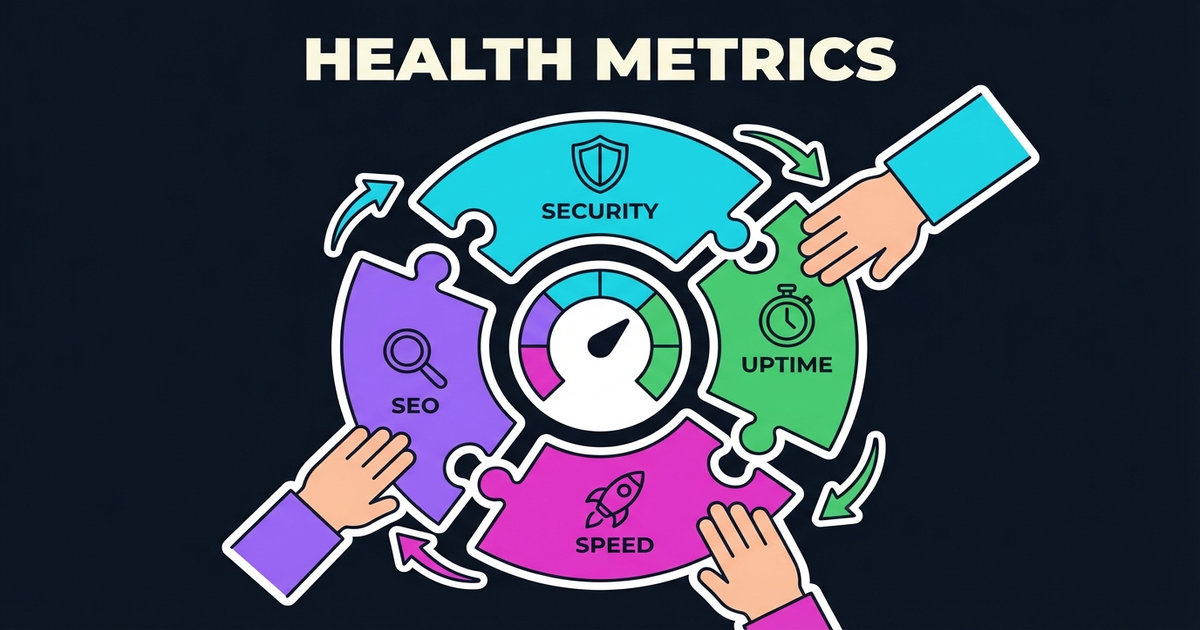
The Four Pillars
Your health score is calculated from four categories:
- Uptime & Availability (25%)
- Security (25%)
- Performance (25%)
- SEO & Discoverability (25%)
Each pillar contributes equally because each matters equally. A fast, well-optimized site that's down is useless. A secure site that nobody can find isn't helping your business.
Pillar 1: Uptime & Availability (25%)
What We Check
- Is the site responding? (HTTP 200)
- How fast is the response? (Time to first byte)
- Is SSL valid? (Certificate not expired)
Scoring
- Site up with good response time: Full points
- Site up but slow (>3s TTFB): Reduced points
- SSL expiring within 30 days: Warning, reduced points
- SSL expiring within 7 days: Critical, major reduction
- Site down: Zero points for this pillar
Why It Matters
If your site isn't reachable, nothing else matters. SSL issues destroy trust instantly—browsers show scary warnings.
Pillar 2: Security (25%)
What We Check
- Dependency vulnerabilities (via GitHub Advisory Database)
- Vulnerability severity (Critical, High, Medium, Low)
- Outdated packages (potential security risk)
Scoring
- No vulnerabilities: Full points
- Low/Medium vulnerabilities: Minor reduction
- High vulnerabilities: Significant reduction
- Critical vulnerabilities: Major reduction
- Multiple critical vulnerabilities: Near-zero
Why It Matters
One critical vulnerability can lead to data breaches, defacement, or worse. We weight severity heavily because a single critical issue is worse than ten low-severity ones.
Pillar 3: Performance (25%)
What We Check
- Performance score (from PageSpeed Insights)
- Core Web Vitals:
- LCP (Largest Contentful Paint)
- CLS (Cumulative Layout Shift)
- FCP (First Contentful Paint)
Scoring
- Performance 90+: Full points
- Performance 70-89: Good, minor reduction
- Performance 50-69: Needs improvement, moderate reduction
- Performance below 50: Poor, significant reduction
Why It Matters
Google uses Core Web Vitals as a ranking factor. Users bounce from slow sites. Performance directly impacts conversions and SEO.
Pillar 4: SEO & Discoverability (25%)
What We Check
- Basic on-page SEO (titles, meta descriptions, headings)
- Mobile-friendliness (viewport meta tag)
- Crawlability (robots.txt, major issues)
- AI crawler access (are you visible to ChatGPT, Claude, etc.?)
Scoring
- All basics in place: Full points
- Missing meta descriptions: Minor reduction
- Missing title tags: Moderate reduction
- Blocking crawlers unintentionally: Reduction
- Major crawlability issues: Significant reduction
Why It Matters
If search engines (and AI assistants) can't understand your site, you're invisible. Basic SEO isn't optional—it's foundational.
How Scores Combine
Each pillar gives a score from 0-100. Your overall health score is the weighted average:
Health Score = (Uptime × 0.25) + (Security × 0.25) + (Performance × 0.25) + (SEO × 0.25)Score Interpretation
- 90-100: Excellent - Your project is in great shape
- 70-89: Good - Minor issues to address
- 50-69: Fair - Several areas need attention
- Below 50: Poor - Critical issues require immediate action
What Doesn't Affect Your Score
We intentionally exclude:
- Vanity metrics (social shares, backlinks count)
- Arbitrary style preferences (we don't penalize design choices)
- Enterprise-only concerns (multi-region redundancy, etc.)
The score reflects what actually matters for indie projects and small teams.
Why Equal Weighting?
We considered weighting uptime or security higher. But here's the thing:
- A secure, fast, SEO-optimized site that's down is worthless
- An always-up site with critical vulnerabilities is a liability
- A fast, secure site that nobody can find isn't helping your business
Each pillar can independently tank your project. Equal weighting reflects this reality.
Improving Your Score
Your dashboard shows exactly which pillar is dragging your score down:
- Uptime low? Check SSL expiry, investigate downtime
- Security low? Update vulnerable dependencies
- Performance low? Optimize images, reduce JavaScript
- SEO low? Add missing meta tags, fix heading structure
No guessing. No mystery.
---
See your project's health score breakdown. Check your projects.
Get your transparent health score
No black boxes. SlyDuck shows exactly what goes into your project's health score—uptime, security, performance, and SEO. Know what to fix and why.
See Your Score BreakdownJames Wolf
Founder @ SlyDuck
Building SlyDuck: the growth dashboard for vibe coders. Builder, leader, Dad, creator.
Related Articles
The 5-Minute Project Health Check
You just connected a project to SlyDuck. In five minutes, you'll know more about its health than you did in the last six months. Here's what happens.
Stop Checking 5 Dashboards Every Morning
You wake up, grab coffee, and start the ritual: Vercel, then UptimeRobot, then GitHub, then PageSpeed, then... There's a better way.